

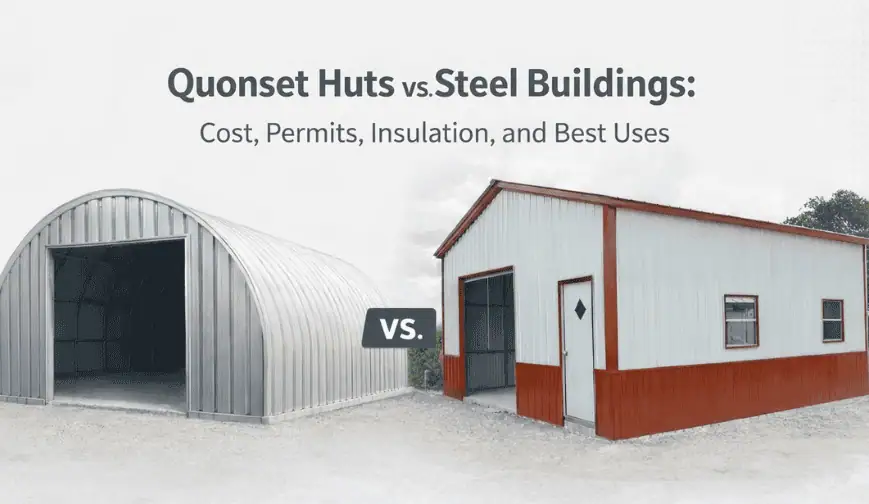
Same Material. Very Different Buildings.
At first glance, a Quonset hut and a steel building can look like they belong in the same category. Steel panels. Large interior. Built to cover equipment or vehicles. But that’s usually where the similarities stop.
The shape of these buildings changes different aspects of the buildings more than most people expect. Interior spaces feel different. Storage works differently. Even basic things like insulation or wall-mounted shelves can turn into completely different projects depending on which style you choose.
A lot of buyers don’t notice that part until they start planning the interior.
Key Takeaways
- Quonset huts rely on a curved arch instead of upright walls
- Straight-wall metal buildings use framed vertical supports
- Curved walls can reduce usable space along the edges
- Flat walls allow shelving and interior framing
- The building kit price is only part of the project cost
- Permit rules often depend on wind ratings and intended use
- Insulation is usually simpler in framed wall systems
- Most garages and workshops use straight-wall metal structures
What Makes These Two Structures Different?
Both buildings are made from steel panels, but the way they carry weight is completely different. A Quonset hut forms a continuous arch. Straight-wall buildings work more like traditional construction, with vertical framing and a roof that sits on top of that frame.
Quonset Huts
A Quonset hut starts at the ground, curves upward, and then comes back down on the other side.
As the walls curve inward, the outer edges lose standing height pretty quickly.
Because of that, these buildings are usually chosen for simpler uses, such as equipment storage, agricultural buildings, or basic shelters.
Steel Buildings
Straight-wall steel buildings rely on vertical supports.
This design allows framed doors, windows, and interior partitions to be installed easily.
This is why garages, workshops, and commercial shops often use this style.
The interior is often easier to work with.
Usable Space: Where the Difference Shows Up
Two buildings can have identical exterior measurements and still feel very different inside. The wall shape alone is a big part of how you can use the space.
Curved interior walls
Inside a Quonset hut, the usable height drops as you move toward the sides. Shelving, tall equipment, or workbenches usually get pushed toward the center.
Straight interior walls
With vertical walls, the full height of the building stays usable all the way across.
Storage along the walls
Flat walls make mounting shelves or cabinets far easier.
Vehicle clearance
Doors on parked vehicles usually open more comfortably near vertical walls.
Interior finishing
Framing, drywall, and insulation all tend to be simpler when the surface is flat.
Looking at the Real Cost
The building kit is the number most buyers see first but it’s rarely the full project cost. There are a few other pieces that almost always enter the picture once construction begins.
Building Kit
This includes steel panels, framing components, and structural pieces that form the building itself.
Ground Work
Sometimes the site is ready to go. Other times, it needs grading, leveling, or drainage work before anything can be installed.
Foundation
Many permanent metal buildings sit on a concrete slab.
Doors and Openings
Garage doors, walk-in doors, and windows usually get added during the design phase.
Interior Work
If the building will be used year-round, insulation and interior panels can add to the project cost.
Permit Questions That Come Up Frequently
Permitting rules are not the same everywhere. Counties and cities often handle them differently. Before ordering a building, many buyers check a few things first:
Are engineered drawings required for approval?
Many building departments require stamped engineering plans before issuing permits.
What wind rating does the building need?
Wind load requirements often vary depending on the region.
Does the foundation need to meet certain specifications?
Local codes may specify slab thickness or anchoring requirements.
Will the intended use change the permit process?
Agricultural, residential, and commercial structures may follow different rules.
Are there zoning restrictions for placement?
Property setbacks or height limits may influence where the building can go.
It’s easier to confirm these early rather than adjusting plans later.
Insulation and Condensation
Steel reacts quickly to temperature changes. Anyone who has stepped into an uninsulated metal building on a hot day has seen this firsthand. Warm air hits the cooler metal panels, and moisture forms. Insulating both of these structure types can reduce this, but the process can vary in terms of cost and install difficulty.
Insulation systems
Straight-wall buildings typically support multiple insulation styles.
Moisture control
Vapor barriers or reflective layers help reduce condensation.
Installation timing
Installing insulation during construction is much easier than adding it later.
Curved surfaces
Quonset huts sometimes require extra effort because the walls aren’t flat.
Flat framing
Straight-wall buildings simplify insulation installation.
When Quonset Huts Make Sense
Quonset huts have been around for decades. There’s a reason they’re still used today. They’re strong, fairly simple structurally, and often work well for basic storage.
They’re best for:
- Equipment storage
- Hay and feed buildings
- Farm supply storage
- Simple repair spaces
- Utility buildings for tools or materials
For straightforward shelter, they definitely do the job.
Where Straight-Wall Steel Buildings Are Usually Chosen
For projects that need flexibility, straight-wall metal buildings tend to win out.
The interior behaves more like a traditional structure, and that makes it easier to adapt the building later.
They’re best for:
- Garages for cars or trucks
- RV storage
- Workshops and hobby spaces
- Farm equipment buildings
- Small warehouses or commercial shops
- Residential barndominium projects
The ability to modify the interior becomes a big advantage.
Roof Design and Weather Performance
Roof style can play a big role in how buildings perform against rain, snow accumulation, and wind exposure. These are roof types you’ll encounter and how they tend to hold up against tough environments:
Curved roofs
The arch design of Quonset hut roofs sheds water naturally and allows wind to move across the structure.
Regular roofs
This is a standard roof type for rolled steel metal buildings. They’re made for moderate environments, but don’t hold up as well as others when it comes to high winds and heavy snowfall.
A-frame roofs
This roof type features a sharper peak and horizontal ribbing. It’s stronger than regular roofing, and does well in most moderate climates.
Vertical roof panels
This is the strongest roofing type for standard metal buildings. The vertically arranged paneling allows snow and storm debris to fall harmlessly from the roof, making it the one of the best options for regions with heavy snow accumulation.
Choosing Between the Two
For many buyers, the decision comes down to how the building will actually be used. Some people simply need a durable shelter for equipment. Others want something that behaves more like a garage or shop.
A Quonset hut might be the right fit if:
- The building is mainly for storage
- Finished walls are not important
- The curved interior space isn’t a concern
A straight-wall steel building may work better if:
- You plan to add garage doors or partitions
- You want a workshop or multi-purpose building
- The interior might eventually be finished for living space
The intended use usually makes the choice clear.
Why Buyers Choose Direct Metal Structures
Direct Metal Structures provides certified metal buildings that are designed to meet your regional wind and snow load standards. They’re built tough, tailored to your way of life, and ready to serve you well for decades to come.
When you work with us, you’ll always receive:
- Metal buildings engineered for local loads
- Extensive customization options
- Delivery and installation included
- Strong warranty coverage
- Dedicated support throughout the project
- Assistance with permitting questions
Want to know more? Call us at 888-277-7950 for more details. Customers can also experiment with our online 3D Designer tool to begin planning their building layout.
Your Questions Answered
1.
Are Quonset huts cheaper than steel buildings?
Answer: Sometimes, especially for simple storage structures. Final costs still depend on size, foundation work, and customization.
2.
Are Quonset huts harder to insulate?
Answer: They can be. Curved interior panels sometimes require different insulation methods.
3.
Do Quonset huts require permits?
Answer: Most permanent structures do, including Quonset huts.
4.
What are Quonset huts usually used for?
Answer: Agricultural storage, equipment protection, and general utility buildings.
5.
Why do garages often use straight-wall metal buildings?
Answer: Vertical walls provide more usable interior space and simplify shelving and insulation.
6.
Are doors and windows easier to add to steel buildings?
Answer: Generally yes. Straight-wall framing makes it easier to install openings and interior finishes
