

Metal Carports in High-Wind
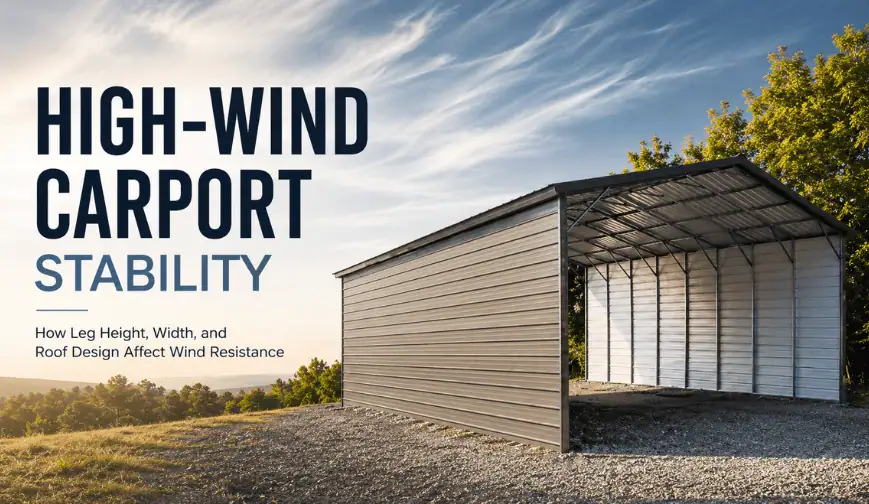
Metal carports are open structures, which means wind moves directly across the frame without the help of enclosed walls to distribute the load. Because of that, performance in high winds depends heavily on the framing and its engineering.
Three key factors play the biggest role in how a carport handles wind: leg height, building width, and panel placement. Each one influences how the structure responds to pressure and how it performs over time.
This guide breaks down how those elements work together, so you can better understand what goes into a carport designed for high-wind environments.
Key Highlights
- Open carports rely heavily on roof framing, anchors, and panel configuration for wind stability.
- Taller leg heights increase leverage at the anchor points and typically require stronger anchoring systems.
- Wider carports experience greater lateral wind pressure across the roof span.
- 12-gauge framing provides greater rigidity than 14-gauge framing for wide-span or tall-leg carports.
- Additional bays help distribute wind loads by shortening the distance between support points.
- Vertical roof panels offer the strongest wind performance for most high-wind regions.
- Concrete anchors are commonly recommended for taller or engineer-certified carports.
Why Open Carports Are Uniquely Vulnerable to Wind
Enclosed metal buildings benefit from wall panels that help brace the structure and distribute lateral force across the frame. Open carports work differently. Without enclosed walls, wind moves more freely around and under the structure, placing greater demands on the roof system, framing, and anchor connections.
Open carports are more affected by wind due to:
Limited lateral bracing
Enclosed buildings use wall panels as part of the overall structural system. Open carports rely primarily on the legs, roof framing, and anchors to resist side-to-side movement during strong wind events.
Increased uplift exposure
Wind can move beneath an open carport roof more easily than it can with enclosed structures. This upward pressure creates uplift force at the roof and transfers additional stress into the anchors and framing connections.
Greater dependence on anchoring
Since open carports lack fully enclosed walls, anchor points play a larger role in maintaining stability. Proper anchors and foundation preparation become especially important in high-wind regions.
More direct pressure on the roof panels
Roof panels on open carports absorb much of the wind load directly. Panel orientation, roof style, and framing strength all influence how effectively the structure handles sustained wind pressure.
How Leg Height Affects Wind Stability in Open Carports
Leg height plays a major role in how wind forces move through a carport structure. As the legs become taller, the distance between the roof system and the ground increases. This creates greater leverage at the base of each support leg, increasing the rotational force transferred to the anchors during high winds.
In simple terms, taller structures allow wind to apply force farther away from the ground connection point. The higher the roof sits, the greater the load acting on each anchor and framing connection. That does not mean taller carports are a bad or lesser choice. It simply means that taller structures require stronger engineering and anchoring to account for the added height.
For many buyers, additional height is necessary for RV storage, agricultural equipment, trailers, or commercial vehicle access. Matching the right framing gauge and anchor system to the building height helps maintain long-term structural performance.
Standard vs. Taller Leg Heights
Residential carports commonly use leg heights between 6 and 8 feet. These heights work well for standard vehicles, everyday residential use, and lower-profile storage needs. Taller builds are selected when additional clearance is needed for larger equipment or vehicles.
Taller leg heights between 10 and 14 feet or more are commonly used for RVs, lifted trucks, tractors, campers, and commercial equipment.
Increased height adds leverage at anchor points, which is why taller structures are typically paired with stronger anchoring systems and heavier framing.
A 20-foot-wide carport with 12-foot legs will transfer more rotational force to each anchor point than the same structure with 8-foot legs. This is normal and is addressed through proper engineering and anchor selection.
Need extra clearance for trucks, vans, RVs, or equipment? Explore a 30x40x12 vertical roof carport, use the 3D Estimator, or call 888-277-7950 to design around your vehicle height.
Leg Height and Anchor Requirements
Anchor selection becomes increasingly important as leg height increases. Taller structures place more demand on base connections due to added leverage from height.
Concrete anchors are widely used for taller carports because they provide strong, stable connection points to a prepared slab.
Ground and auger anchors may also be used, depending on soil type, site conditions, and local code requirements.
Proper anchor selection should always align with local wind load requirements and building guidelines. For a deeper look at soil-based and concrete-based installation, read DMS’s guide on ground vs. concrete RV carport installation.
How Building Width Affects Wind Performance
Building width also influences how a carport performs in high winds. As a structure becomes wider, the roof spans a greater horizontal distance. That larger surface area allows more wind force to act across the roof system and framing connections.
Wider spans place additional demand on the support legs, braces, roof framing, and anchor points. For this reason, larger carports often benefit from heavier framing gauges and additional structural support to help control movement and reduce deflection under load.
Wider Carports and Gauge Requirements
Wider structures place more stress across the framing system, which is why gauge selection becomes more important as the span increases. Steel thickness directly impacts rigidity and deflection under wind load.
Carports wider than 18 to 20 feet often benefit from 12-gauge framing for improved rigidity and reduced deflection.
12-gauge steel is thicker than 14-gauge steel, which helps the structure resist bending and flexing under wind pressure.
14-gauge framing is commonly used for standard residential builds, while 12-gauge is preferred for wider or higher-demand applications.
Bay Count and Wind Load Distribution
Bay spacing determines how far apart support legs are placed along the structure. Adjusting the bay count changes how wind loads are distributed across the frame.
Adding more bays shortens the distance between support points, which reduces stress on individual connections.
Shorter spans help distribute wind forces more evenly across the structure.
Increasing bay count is a practical way to improve stability on longer or wider carports without changing the entire framing system. If you need more covered length for vehicles, trailers, or equipment, a 30x50x12 metal carport is one example of a longer carport layout.
How Panel Placement and Roof Style Affect Carport Wind Resistance
Roof style and panel orientation have a direct impact on how a carport handles wind exposure. Panel direction influences how wind pressure moves across the roof surface, while roof shape affects uplift resistance and structural airflow.
Vertical Roof Panels: Best Option for High-Wind Regions
Vertical roof panels run from the ridge down to the eave, allowing wind, rain, and debris to move more efficiently off the structure. This orientation reduces pressure buildup and improves overall roof performance in demanding environments.
Vertical panels help reduce uplift pressure by allowing wind to flow more naturally across the roof surface.
The top-to-bottom panel layout creates stronger load transfer into the framing system.
Vertical roofs are commonly recommended for high-wind regions and engineer-certified structures.
This roof style is often required for buildings designed to meet stricter wind load standards.
Comparing roof styles? Review DMS’s guide to Regular vs. A-Frame vs. Vertical Roof, then explore vertical roof metal carports if wind, rain, or debris shedding is a priority.
A-Frame (Boxed-Eave) Panels: Moderate Wind Acceptable
A-frame roof systems use horizontal panels with a peaked roof design. This style offers improved performance compared to basic curved roofs while maintaining a residential appearance.
Horizontal panels provide solid performance in moderate wind environments.
Slightly more uplift pressure can occur at panel connection points compared to vertical systems.
A-frame roofs are a strong option for many inland and suburban locations.
Regular Roof Panels: Not Recommended for High-Wind Areas
Regular roof systems use curved framing with horizontal panels that follow the arch of the structure. This design is commonly used in lower-wind regions where extreme wind exposure is not a primary concern.
Curved framing creates more surface exposure during high-wind events.
Horizontal panel layout increases uplift pressure compared to vertical or A-frame systems.
Regular roofs are best suited for calm-weather environments and light-duty applications.
Wind Stability Variable Reference Table
| Variable | Wind Effect Explanation | Guidance |
|---|---|---|
| Leg Height (taller) | Increases torque at anchor points | Keep height appropriate for use; taller = stronger anchors required |
| Building Width (wider) | More surface area = higher lateral load across the span | Wider carports need heavier gauge steel, more bays, and stronger anchors |
| Open vs. Enclosed Sides | Open sides allow wind-through but reduce wall load; trade-off | Open structures rely heavily on roof and leg connections for stability |
| Vertical Roof Panels | Panels run top-to-bottom; rain/debris sheds off; reduces uplift vs. horizontal | Best choice for high-wind regions; required for engineer-certified builds |
| A-Frame (Boxed-Eave) Panels | Panels run horizontal; some uplift exposure at ridge; better than regular | Acceptable for moderate wind; vertical is preferred for high-wind zones |
| Regular Roof Panels | Panels follow roof curve; highest uplift exposure in wind events | Better suited for lower-wind regions |
| 12-Gauge Framing | Thicker steel = less deflection under lateral and uplift loads | Strongly recommended for wide-span or high-leg carports in wind zones |
| 14-Gauge Framing | Standard residential framing; suitable for lower-wind regions | Check local wind load requirements before choosing |
| Concrete Anchors | Strong resistance to pull-out; distributes load across slab | Commonly recommended for high-wind installations and permits |
| Auger / Ground Anchors | Penetrates soil; performance varies by soil type and moisture | Suitable for some non-permit installs, depending on site conditions |
Why Choose Direct Metal Structures for a High-Wind Metal Carport?
At Direct Metal Structures, we offer a wide selection of metal carports, metal garages, agricultural metal buildings, and commercial steel structures engineered to meet local wind and snow load requirements. No matter where you live, you can choose a structure designed for your region’s climate and performance needs.
When you work with Direct Metal Structures, you get:
- Local knowledge of wind and snow loads
- Dedicated customer service
- Certified designs for your region’s weather
- Included delivery and installation
- Flexible financing and rent-to-own plans
Ready to get started? Call our team today at 888-277-7950 or design your structure online using our 3D Estimator tool.
Want a carport with more side coverage or storage flexibility? Compare options like a metal carport with extended panels or a 20x50x12 utility carport, then call 888-277-7950 to match the layout to your site and use case.
Final Thoughts on Carports in High Wind Environments
High-wind performance in an open carport depends on how the entire structure works together. Leg height, building width, framing gauge, panel placement, roof style, and anchor selection all influence how wind forces move through the building. Choosing the right combination of these features helps improve long-term stability and structural performance.
For many buyers, the best approach is selecting a carport that is designed specifically for their local weather conditions. With the right engineering and installation approach, metal carports are a dependable way to protect your vehicles in any environment.
Your Questions, Answered
1.
Does leg height affect carport wind stability?
Answer: Yes. Taller leg heights create more leverage at the anchor points, which increases the structural demand on the frame and anchors during high winds.
2.
Why do open carports fail in wind more than enclosed buildings?
Answer: Open carports do not have enclosed wall panels that help distribute lateral wind forces. Because of this, the structure relies more heavily on the roof framing, support legs, and anchors to maintain stability.
3.
Is a vertical roof better for a high-wind carport?
Answer: In many high-wind regions, yes. Vertical roof panels help reduce uplift exposure and allow wind, rain, and debris to move more efficiently off the roof surface.
4.
Does building width make a carport more vulnerable to wind?
Answer: Wider carports experience more lateral wind force across the roof span because of the larger surface area.
5.
What anchors do I need for a carport in a high-wind area?
Answer: Concrete anchors are commonly recommended for high-wind installations because they provide a strong connection to the foundation.
6.
Does Direct Metal Structures offer engineer-certified carports for wind zones?
Answer: Yes. Direct Metal Structures offers engineer-certified carports that are designed to meet your wind and snow load requirements. You can also review when engineered plans for a metal building may be needed during the permit process.
